A Computational Model of Arbitration between Model-Based and Model-Free Learning (Featuring Django Unchained!)

Decision-making has fascinated both neuroscientists and economists for decades; and in particular, what makes this such an intriguing topic isn't when people are making good decisions, but when they are screwing up in major ways. Although making terrible decisions doesn't necessarily bar you from having success - just look at our past six or seven presidents - alleviating terrible decisions can sometimes make your life easier, especially when it comes to avoiding decisions that could be bad for you, such as licking a steak knife.

A recent Neuron paper by Lee, Shimojo, and O'Doherty examined how the brain switches between relying on using habitual actions to make decisions, versus generating a cognitive model of what decisions might be associated with which outcomes, and making a decision based on your prediction about what should be most optimal, similar to making a decision-tree or flowchart outlining all the different possibilities associated with each action. These decision-making strategies are referred to as model-free and model-based decision systems, respectively; and reliance on only one system, especially in a context where that system might be inappropriate, would lead to inefficiencies and sometimes disastrous consequences, such as asking out your girlfriend's sister. O'Doherty, who seems to churn out high-impact journals with the effortlessness of a Pez Dispenser, has been working on these and related problems for a while; and this most recent publication, to me, represents an important step forward in computational modeling and how such decision-making processes are reified in the brain.

Before discussing the paper, let me clarify a couple of important distinctions about the word "errors," particularly since one of the layers of the model discussed in the paper calculates different kinds of error. When computational modelers talk about errors, they can come in multiple forms. The most common description of an error, however, is some sort of discrepancy between what an organism is trying to do, or what an individual is expecting, and what that organism actually does or actually receives. Errors of commission, in particular, have been extensively studied, especially in popular decision-making and reaction-time paradigms such as the Stroop task, which is simply screwing up or making an unintended mistake; but recently other forms of error have been defined, such as reward prediction error, which calculates the discrepancy between what was expected, and what was actually received. The authors contrast this reward prediction error with a related concept called state prediction error, which is the discrepancy between an internal model of the environment and the actual state that someone is in. So, actions that are appropriate or likely to be rewarded in one state, may no longer be valid once the state is detected to have shifted or somehow changed.

While this may sound like so much jargon and namby-pampy scientific argot, state prediction errors and reward prediction errors are actually all around us, if we have eyes to see. To take one example, near the end of Django Unchained, our protagonist, Django, has killed all of Calvin Candie's henchmen in a final climactic shootout in the CandyLand foyer. Stephen, thinking that Django has spent all six revolver rounds in the shootout - including a particularly sadistic dismemberment of Billy Crash - believes that he still has some options left open for dealing with Django, such as continuing to talk trash. However, when Django reveals that he has a second revolver, Stephen's internal model of his environment needs to update to take this new piece of information into account; actions that would have been plausible under the previous state he believed himself to be in are no longer viable.

A reward prediction error, on the other hand, can be observed in the second half of the scene, where Django lights the dynamite to demolish the CandyLand mansion. After walking some distance away from the manse, Django turns around to look at the explosion; clearly, he predicts the house to explode in an enormous fireball, and also predicts it to occur at a certain time. If the dynamite failed to go off, or if it went off far too early or too late, would lead to a prediction error. This distinction between the binary occurrence/non-occurrence of an event, as well as its temporal aspect, has been detailed in a recent computational model of prediction and decision-making behavior by Alexander & Brown (2011), and also illustrates how a movie such as Django Unchained can not only provide wholesome entertainment for the whole family, but also serve as a teaching tool for learning models.


This brings us to the present paper, which attempted to locate where in the brain such an arbitration process is done in order to select a model-based or model-free decision system. A model-free system, as described above, takes the lesser amount of cognitive effort and control, since using habitual or "cached" behaviors to guide decisions is relatively quick and automatic; model-based systems, on the other hand, require more cognitive control and mapping out prospective outcomes associated with each decision, but can be more useful than reflexive behaviors when more reflection is appropriate.

The task required participants to make either a left or right button press, which would make a new icon appear on the screen, and after a few button presses, a coin would appear. However, the coin was only rewarding in certain circumstances; in one condition, or "state," only certain colors of coins would be accepted and turned into rewards, while in the other condition, any type of coin would be rewarding. This was designed to favor either model-free or model-based control in certain situations, and also to compare how an arbitration model would correlate with behavior that either is more flexible under model-based conditions, or more fixed under model-free conditions, using a dynamical threshold to shift behavior from model-based to model-free systems over time. The arbitration model also computes the reliability of the model-based and model-free systems to determine which should be implemented, which is affected by prediction errors on previous trials.

Figure 2 from Lee et al showing how prediction errors are computed and then used to calculate the reliability of either a model-based or model-free system, which in turn affects the probability of implementing either system.

The authors then regressed the computational signals against the FMRI data, in order to see where such computational signals would load onto observed brain activity during trials requiring either more or less model-based or model-free strategies. The reliability signals from the model-free and model-based systems were found to load on the inferior lateral PFC (ilPFC) and right frontopolar cortex (FPC), suggesting that these two cortical regions might be involved in the arbitration process to decide which system to implement, with the more reliable system being weighted more.

Figure 4, ibid, with panel A depicting orthogonal reliability signals for both model-based and model-free systems in bilateral ilPFC. Panel B shows a region of rostral anterior cingulate cortex associated with the difference in reliability between the two systems, and both the ilPFC and right FPC correlated with the highest reliability index for a particular trial for whichever system was implemented during that trial.

Next, a psychophysiological interaction (PPI) analysis was conducted to see whether signals in specific cortical or subcortical regions modulated the activity of model-free or model-based signals, which revealed that when the probability of a model-free state was high, there was a corresponding negative correlation between both the ilPFC and right FPC and regions of the putamen also observed to encode model-free signals; significantly, no effects were found for the reverse condition when the probability of model-based activity was high, suggesting that the arbitrator functions primarily by affecting the model-free system.

In total, these results suggest that reliability signals for different decision systems are modulated by activity in the frontocortical regions, and that signals for the model-based and model-free systems themselves are encoded by several different cortical regions, including the orbital PFC for model-based system activity, and supplementary motor area and dorsolateral PFC for model-free activity. In addition, the ventromedial PFC appears to encode a weighted signal of both model-based and model-free signals, tying together how subcortical and value-computing structures may influence the decision to either implement a model-based or model-free system, incorporating reliability information from frontopolar regions about which system should be used. Which, on the face of it, can be particularly useful when dealing with revolver-wielding, dynamite-planting psychopaths.


Link to paper

Saving Cluster-Corrected Images in SPM

Once you've loaded up a contrast in SPM and thresholded it at a particular correction threshold, such as cluster corrected or FWE corrected, you can then simply save that image into a .hdr/.img file for use in another viewer, such as MRIcron. Just push the save button in the results window, and there you have it. This image can also be used for other purposes, such as doing an ROI analysis within only those voxels passing a corrected threshold for a given contrast.

Cluster-corrected image in the SPM interface

Same image, but saved out into .hdr/.img format and viewed in MRIcron.

In case it isn't clear how to do this from the above, I've also made an instructional video about how to do it, which - if you can believe it - was done in only one take. I have my little victories.


Q & A Session with Andy's Brain Blog

Several of you have written in, and, after just enough time to both come up with well-reasoned answers and to slightly irritate you, I have responded. To be honest, not that many people write me - as in, maybe one or two - so I've also included a couple of so-called "made-up" questions to flesh out the direction that the blog is heading, as well as "hardball" questions, such as what my stance is on the current political situation in Ukraine, or whether eating all that Nutella has permanently changed the color of my urine.

Q: Why haven't you responded to my requests to join a Google Discussion?
A: To be honest, I thought that some of those things were spam. As you may have guessed, I'm not that technologically savvy with these kinds of things. However, I will do my best to respond to you as soon as possible.

Q: Where have all the Google Ads gone? What will I click on now?
A: As much as we all loved the Google Ads, I think they're gone for good this time. I think the turning point was when I saw an ad on my own site about finding attractive singles in my area. I mean, why should I need any help finding attractive singles in my area? The very idea is absurd! Ask anyone!

In any event, I found the ads distracting from the real purpose of this blog, which is to educate, edify, and ennoble. Also, incidentally, I wasn't making diddly-squat in the way of ad revenue.

Q: A while ago you promised to make videos on resting-state functional connectivity, DTI analysis, and, possibly, how to dress professionally. Where are they?
A: I'll be upfront with you - once I found out that making tutorials about those things took, like, effort, I tended to back down and procrastinate. But no more; I have my first post on resting state connectivity in the works, and it will be released one week from now, on February 26th. Subject to change, of course.

Q: Are we still in Q-and-A format?
A: Yes.

Q: What is the purpose of graduate school?
A: To seek the truth; to discover the good life; to use your knowledge and your profession to unite and harmonize what is both highest and lowest within you; to look to past examples of conduct for guidance and inspiration; to be as Odysseus, who, as Dante tells us, went forth to see the virtues and vices of men, and to study as Machiavelli, who snatched a few hours from each busy day to don regal clothing and hold court with ancients.

Hah! Just kidding, folks. The real purpose of graduate school is to wedge yourself deeper into the crevice of your specialization, until you are unable to see anything outside of your immediate surroundings; and, in the meantime, prepare yourself for a career of "making it," a perpetuum mobile existence filled with endless business and babbitry. The sooner you embark upon this path and embrace it, the less friction you will feel between it and the rest of your life, resulting in less discord and more satisfaction with yourself; which is the goal of any successful person.

Q: Why do you find the need to sermonize and pontificate so much?
A: Runs in the family, I think.

Q: What changes will there be to the blog in the future?
A: Right now I am trying to get higher-quality recording equipment from the educational school here at IU to make better videos. Also, there might be a shift in focus to more neuroanatomy and review of papers, especially ones that are relevant to my dissertation, i.e. the neuroscience of decision-making and computational modeling. We'll see how this works out, and what kind of response it gets. And I really do appreciate any feedback you can give me, and I would also like to thank those of you who have already given comments about what works, and about what could be improved. You are truly fantastic, and I am grateful for each and every one of you! Also, if you could send me some documentation proving that you are one of my dependents, for tax purposes (you know how those taxes are), that would be great.

Q: Thanks! I guess that's it for now.
A: That's not a question. 

The Will to Persevere, Induced by Deep Brain Stimulation

Scientists, and neuroscientists in particular, are an odd bunch, with complex, multifaceted personalities. on the one hand they can be reclusive, socially awkward, and pretentious; but, in their defense, they make an honest effort to try and make up for these defects by being completely nuts.

For example, although most neuroscientists won't admit it, deep down, in their heart of hearts, somewhere in the left atrium, each and every one of feels a little twinge of excitement at the prospect of sticking electrodes somewhere in a person's brain and delivering electrical shocks. Seriously. Just ask any self-described neuroscience researcher what he would love to do most, and nine times out of ten he will say "Stick things inside someone's brain and inject enough electricity into it to light up a small amusement park." Only rarely will he give a more reasoned, more mature answer, such as "Purchase a motorcycle," or "Become an adult film star."

In any case, neuroscientists are usually prevented from acting out their sick fantasies by institutional review boards, or IRBs, which, from a neuroscientist's point of view, exist solely to be squeamish buzzkills and to put your experiments under review for a length of time equivalent to the gestation period of a yak. However, every once in a while there will be a case where an epileptic patient is undergoing a craniotomy, for example, or where a fellow neuroscientist is receiving extensive brain surgery after his latest motorcycle accident; and these cases, in addition to being like the Irish Sweepstakes for neuroscientists, can also yield valuable insights about how direct stimulation of cortical and subcortical areas can induce different physiological and cognitive states.

A recent example of this type of research appeared in a paper in the journal Neuron a couple of months ago, by Parvizi et al. Two epilepsy patients had deep-brain electrodes implanted in their brain, and the researchers were particularly interested in those electrodes located within the midcingulate region of the anterior cingulate cortex (ACC). After delivering small bursts of electricity to these electrodes, the patients reported higher levels of autonomic system activity, including increased heart rate and alertness, along with a feeling of foreboding but a concomitant feeling of resolve to overcome the intangible "challenge" that they felt. A follow-up resting-state analysis showed that both of these seed stimulation regions were hubs of a widespread cingulo-opercular network, similar to the typical coactivation of cingulate and insula responses observed in most studies examining the medial prefrontal cortex, and also involved in detecting emotional salience and sustaining goal-directed activity.

Figure 1 from Parvizi et al, showing the stimulation site in the midcingulate region for both patients, as well as more remote stimulation sites for comparison.


Figure 2 from Parvizi et al depicting a resting-state functional connectivity analysis using the midcingulate as a seed region.

The authors labeled these feelings of wanting to overcome a formidable challenge as the "will to persevere," a phrase I think will be variously interpreted, but which seems apt enough for the current paper. However, one concern that popped into my head while reading through the article (dons reviewer glasses, purses lips disapprovingly) was: Is it really a will to persevere, or just a general increase in autonomic nervous system arousal (i.e., the sympathetic branch)? The "will to persevere" reported here may be the patient's interpretation of his increased heart rate, which, given the circumstances of the experiment and the patient's undergoing surgery to treat his epilepsy, may reflect his desire for a successful outcome of the surgery. Placing the patient in a different environment or with different circumstances - say, locking him in a room with one of the facehuggers from the movie Alien - may lead to a reinterpretation of the same increased arousal as fear, instead of a general willingness to overcome the challenge that lays in front of him.

In any case, these results, coupled with the lack of emotional response to electrical charges delivered to control stimulation sites and sham stimulations, lends support to the theory that the midcingulate region plays some kind of role in motivation, and that stimluation to this region may have practical applications for disorders involving pathologically low amounts of motivation, such as major depression and senioritis; disorders which, I might add, I am fully qualified to treat with open-brain surgery and a homemade electrical stimulation kit consisting of copper wire and a couple of lemons. Just give me a call.


Link to paper (including video of interview with subject 1; scroll to bottom of page): http://www.sciencedirect.com/science/article/pii/S0896627313010301

Andy's Brain Blog: Valentine's Day Edition

For those who have been in academia for nearly their entire life, the stage at which one is nearly done with their graduate work, around the time they are in their late twenties or early thirties, is a good time to start thinking about dating.

Luckily, whereas our ancestors were all a bunch of stiff-necked prudes who knew next to nothing about amorous affairs, today all of our race's available knowledge about love and relationships has been synthesized and condensed into the minds of a very few select sages, by which I mean: Pick-Up Artists.

These people, out of their generosity, have decided to share their wisdom and insights through various books, TV shows, and websites, in order to make their disciples as happy and fulfilled as possible. The fact that their advice seems to constitute what more old-fashioned people would call "narcissistic," "anti-social," or "I'm pretty sure doing that would get you arrested in most countries," should not deter you from following their instructions. Neither should the fact that they tend to dress up as, say, meth addicts.

Famous Pick-Up Artists

In any case, it is clear that following the advice of these people is better than doing nothing. Under no circumstances should you assume that you, some loser dirtbag, knows better than they do.

Fortunately, after reading through their books and listening to their lectures, I've been able to boil down their ideas into a few main points. Simply follow these, and then sit back and wait for the babe stampede.


1. Be assertive. Girls like guys who are assertive, which, contrary to popular belief, doesn't mean just being confident about who you are and forthright about what you believe; instead, it means being brash enough and loud enough to the point where anyone else around you who wants to talk either has to talk louder than you are or talk directly at you, ensuring your control of the conversation and your immediate environment; a technique, incidentally, that has been perfected on several political talkshows.

The reason girls are attracted to this can be explained by the theory of evolution, which states that females, being insane, prefer to copulate with psychopathic jerks, because it's good for the survival of the species, somehow. (Actually, to be honest, I have no idea why this is the case, and using evolution to explain it always seems like kind of a cop-out; similar to using natural selection to explain why humans have formed such horrifyingly self-destructive activities such as war, or home-improvement projects.)

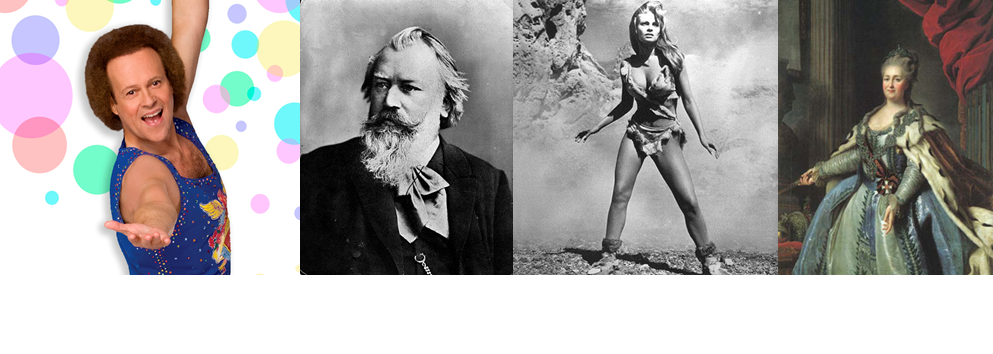
2. Be Charismatic. Girls like guys who are charismatic. Having charisma means being able to persuade and influence other people into doing things they would not otherwise do, such as dating you, or eating a used tissue. Having charisma also means being able to attract people by the sheer magnetism of your personality, as exemplified by the following famous historical figures:

What do each of these people have in common? That's right: They're all murderous sociopaths! Having a few screws loose is, unfortunately, often highly correlated with charisma. But then again, everybody likes a little spice in their relationship.

3. Be Witty. Girls like guys who are witty. Ideally, you should constantly be making remarks that reflect your sophistication and vast erudition cultivated over the years by reading poetry and great works of world literature, and possibly one or two neuroscience blogs. Eschew lowbrow, vulgar subjects and try to keep your witty remarks limited to more refined topics such as classical music, literature, and competitive eating.

Example: "Nietzsche's Ăœbermensch is very much like Wagner's Siegfried, except that he knows Greek. Also, care to guess what my Chubby Bunny record is?"

4. Be Conspicuous. In order to be noticed, it helps to have some attribute that makes you stand out apart from the herd. It can be something as simple as donning garish clothing, sporting a new hairstyle, or developing a personality disorder. Be creative. I'm told that histrionic types are in style these days.

That's about it, and once you have all of these bases covered, success is all but guaranteed. Over time you may even find yourself in a relationship with this person you have managed to attract; and while it may be hard to determine whether you are, exactly, in a relationship, one or more of the following signs may mean that you are indeed in some kind of commitment:
  1. You find yourself celebrating a five-year wedding anniversary;
  2. You have just witnessed the birth of your third child with this person;
  3. You find you and your significant other frequently engaging in "committed relationship" activities such as eating together, sleeping together, and trimming each other's nose hairs.
On a more serious note, I wish you all have a wonderful Valentine's Day that isn't plagued by doubt, insecurity, and loneliness. Many people tend to hate on Valentine's Day, labeling it as a cynical marketing ploy by the nefarious Card Industry, the abominable Flower Industry, and Big Chocolate; however, this tends to obscure the fact that this holiday tends to occur on a typically dreary, cold, slushy day during which everyone is trying to drive to fancy restaurants, and that somehow the malefic Road Salting Union may be involved as well.

In any case, I hope that the preceding advice works, and if it doesn't, I even more sincerely hope that you don't come running after me with a machete. Remember that this is the distilled advice of literally half a dozen or so self-described experts and possible drug abusers - and they can't all be wrong, can they?

Using R to Do Your Statistics and Crush Your Enemies (Maybe)


Over the course of my checkered career as a graduate student drudge, one of the best resources I have found for learning R, and, more importantly, actually getting it to do useful stuff, is the R guide from the Personality Project over at OSU. I encourage anyone interested in R to check it out, especially since my own experience with R got off to a rocky start; my introductory graduate course in statistics used R, but the instruction was so spotty and the concepts so difficult to understand that one day, instead of calculating a simple t-test like I wanted to, I accidentally ended up bypassing the Pentagon's firewall and starting a countdown for a nuclear warhead to be launched at Zimbabwe, which was stopped remotely at the last second by Edward Snowden.

The point is that R is a powerful language and that, once you become even partially familiar with it, you will be able to carry out basic statistical tests quickly and easily. One of the most instructive sections of the website, for me, is the one on ANOVAs, since I often use this to compare beta weights extracted across different regions of interest and test for double dissociations. Other sections give advice on how to restructure your data to be analyzed in different ways by R, linear regression, and multivariate statistics.

P.S. Some of the examples require links to datasets on the R project website which may no longer be properly linked (e.g., the ANOVA examples use commands like [datafilename = "http://personality-project.org/r/datasets/R.appendix1.data"], but give errors when attempting to read them into a table). I've converted some of them to my personal website, which should make them able to fit into tables without any errors. So, for example, you would use a command like [datafilename=""http://mypage.iu.edu/~ajahn/docs/R.appendix1.data.txt"], and so on for the other datasets.

P.P.S. I was planning to make a short video touring the personality project website and a few of the examples, but I've caught a cold recently, and right now my voice sounds mucusy and gravelly and full of sputum. While it may be pleasing for the ladies to hear my voice like this, it isn't as useful for instructional purposes; and really, that's what I'm all about.

How to Write a Dissertation Prospectus

Before beginning work on a dissertation, one has to put together and submit a prospectus, which is from the ancient Greek pro, meaning "Stuff," and spectus, meaning "One who writes." A prospectus is, in condensed form, what you will be writing about in your dissertation. This provides your dissertation committee, over a period of roughly two presidential administrations, a chance to read a brief, concise, single-spaced 50-page report about whether they should take the trouble to read a future dissertation that, for practical purposes, is measured not in pages but metric tons. Some students, knowing that a picture is worth a thousand words, merely substitute a diagram to helpfully outline what will be covered in their dissertation:


For those of us who aren't savvy enough with Google Images to produce an informative picture, however, we will need to rely on good, old-fashioned scientific prose. But first, let's cover the basic structure of your prospectus. Remember, by following these time-tested principles and recommendations, you will at least somewhat entertain your committee before they reject your dissertation proposal as completely ridiculous and holding about as much scientific merit as a can of Cheez-Whiz.


1. The Cover Page

A strong prospectus starts out with a cover page, containing the title of your dissertation, the names of the members of your dissertation committee, and possibly a dedication to someone who has had an immense and positive influence on your life, such as your parents, your girlfriend, or Tony Soprano. Feel free to embellish your cover page with depictions of cherubs and muses.

Example cover page from Edward Grieg's dissertation prospectus.


2. Personal Photo

Even after four years of working with your adviser, you shouldn't make any rash assumptions, such as that he or she will know what you look like. In order to help out your adviser, you should attach a professionally done personal photo showing you looking as serious and scientific as possible. This can score you major points with your committee, as they will now have a mental image of you as a serious, cultured individual, unlike all the other hirsute weirdos wandering around the department:


Source: Calvin Klein


3. Body of the Prospectus

Once you have successfully completed your cover page and personal photo, you're now ready for the most important and weightiest section of your prospectus - by which I mean, of course, that you actually have to write something related to the work that you have been doing over the past several years. A good prospectus should start out with something that immediately entices and intrigues the reader, such as the following:

Most honorable, sovereign, and magnificent lords,

I herewith enclose the following enclosements; a prospectus designed to please both one's innate curiosity and satisfy his critical faculties, by expounding upon the work of my graduate career, which has definitely involved reading only scientific articles and books, and not bootlegged copies of Humungo Garbanzo BOLD Responses. It is my utmost belief, penetrating my entire being and reaching even so far as the pyloric sphincter, that this prospectus will contribute to the PUBLIC WEAL and common good of academia and the scientific committee, viz., all of you, etc., et al, ora pro nobis.

The dissertation which I hereafter propose is that, in order to determine the neural mechanisms and correlates of prospective model-free decision-making, one must bring to bear several unique methodologies, such as functional and structural connectivity, multivoxel pattern analysis, univariate mastication, seed-based cortical peristalsis, dynamic CSF segmentation and haustral movements, computational modeling region of interest corrected thresholding bread milk Astroglide tortillas refried beans.

Deign, most honourable, magnificent and sovereign lords, to receive, and with equal goodness, this respectful testimony of the interest I take in whatever it is I have been studying the past several years. And, if I have been so unhappy as to be guilty of any indiscreet transport in this glowing effusion of my heart, I beseech you to pardon me, and to attribute it to the tender affection of a true student, and to the ardent and legitimate zeal of a man, who can imagine for himself no greater felicity than to see you happy.

Also, if somehow one of you manages to come across one of my old issues of Humungo Garbanzo stuffed in the back of the lowest drawer of my filing cabinet, I know nothing about that.

Most honourable, magnificent and sovereign lords, I am, with the most profound respect,

Your most humble and obedient servant and fellow-citizen,


Don't worry if you have a difficult time coming up with anything that sounds remotely plausible or scientific; if you've written a prospectus like the one above, odds are that your committee, satisfied that you are fluent in academic bullshit, will stop reading somewhere around the second paragraph, and fail to note that once you ran out of buzzwords you started supplying items from your grocery shopping list.

How to Avoid Common Cluster-Extent Thresholding Pitfalls in FMRI Analyses

Just when FMRI researchers were feeling good and secure about the methods they were using, yet another paper has come out in the journal Neuroimage about how everything you are doing is, to put it mildly, totally wrong.

The article, by Woo, Krishnan, and Wager, points out that one of the most popular correction methods for FMRI data - namely, cluster-correction, or cluster-extent thresholding - is routinely mishandled. This is not to say that you, a typical FMRI researcher, has no idea what he is doing. It is just that, when it comes to cluster-correction thresholding, you are about as competent as a bean burrito.

Cluster-correction is based on the assumption that in an FMRI dataset composed of several tens of thousands of voxels all abutting each other, there is likely to be some correlation in the observed signal between adjacent voxels. That is, one voxel immediately surrounded by several other voxels is not completely independent of its neighbors; the signal in each will be somewhat similar to the others, and this similarity is roughly related to how close the voxels are to each other. Smoothing, another common preprocessing practice, also introduces more spatial interpolations by averaging the signal over several voxels of a specified range, or kernel. Cluster-correction then uses an algorithm, such as Gaussian Random Field (GRF) Theory or Monte Carlo simulations, to determine what number of contiguous voxels at an individual, voxel-wise p-threshold (here in the paper referred to as a primary p-thresholds) would be found due to chance alone; if a cluster of a certain size is exceedingly rare, then most researcher reject the null hypothesis and state that there is a significant effect in that cluster.

However, the authors point out that this can lead to erroneous interpretations about where, exactly, the significant effect is. All that you can say about a significant cluster is that the cluster itself is significant; cluster-correction makes no claims about which particular voxels are significant. This can be a problem when clusters span multiple anatomical areas, such as a cluster in the insula spreading into the basal ganglia; it is not necessarily true that both the insula and basal ganglia are active, just that the cluster is. Large cluster sizes and lax primary p-thresholds, at the extremes, can lead to cluster sizes that are, relative to the rest of the brain, the size of a Goodyear Blimp.


Figure 1 from Woo et al (2014). A: Demonstration of how all of the different correction techniques, when plotted together, looks like a doughnut. Also, cluster-correction is the most popular technique. B and C: Clusters can span several areas, leading to erroneous interpretations about the spatial specificity of activation.

Another issue is that large primary p-thresholds are correlated with larger cluster sizes passing correction. That is, only cluster sizes that are huge will be deemed significant. Obviously, this loss of spatial specificity can be a problem when attempting to study small areas, such as the periaqueductal gray, which is about the size of a strip of Stride gum, as shown in the following figure:

From left to right: Periaqueductal gray, Stride gum, Tom Cruise (all images shown to size)


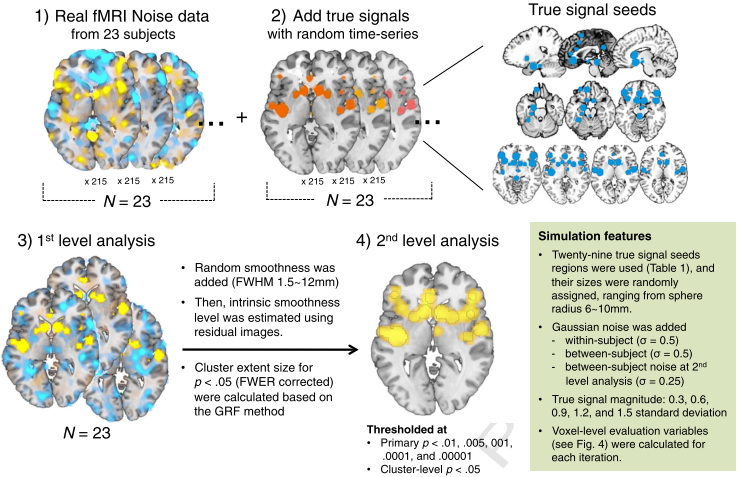
Lastly, the authors ran simulations to show that, even in a simulated brain with clearly demarcated "true signal" regions, liberal primary p-thresholds led to excessively high false discovery rates, a measurement of the number of false positives within a given dataset. (False discovery rate, or FDR, can be used as an alternative significance measurement, in which one is willing to tolerate a given percentage of false positives within a dataset - such as 5% or less - but is agnostic about which voxels are false positives.) This also led to a high amount of clusters smearing across the true signal regions and into areas which did not contain signal:


Figure 3 from Woo et al, 2014

Problems like these can be ameliorated by choosing more stringent primary p-thresholds, such as a voxelwise p less than 0.001, and in cases where power is sufficiently high or in cases where you might suspect that the intrinsic smoothness of your dataset is highly irregular, you may want to eschew cluster correction altogether and use a voxel-wise correction method such as family-wise error (FWE) or FDR. If you do use cluster correction, however, and you still get blobs that look like messy fingerpaintings, it can help the reader to clearly demarcate the boundaries of the clusters with different colors, thereby helping visualize the size and extent of the clusters, and fulfilling some of your artistic needs.


Now go eat your bean burrito.


The Beethoven Piano Sonatas

Warning: Classical music nerditry ahead.  (And some domestic violence.)

One evening while discussing the music of Beethoven with a friend (as is my wont), my conversation companion mentioned that, although Beethoven's music was very beautiful, she didn't see what, exactly, all the fuss was about. "He seems to have figured it out early on in the game, and then didn't change very much," she said. "He just knew what worked, and - OW!!!"

Although I felt bad about strongly pinching her thigh before she could complete her sentence, obviously I could not allow her to continue spewing such mendacity. However, even though our friendship was terminated shortly thereafter, I continued to be needled by her remarks, as her thoughts on the matter are not, it seems to me, an isolated incident. Beethoven seems to be not so much listened to as he is admired, not so much admired as merely accepted. Although plenty of his more popular melodies have permeated our collective ear, several of them have become diluted through overexposure of limited fragments. (How many are aware, for example, that there is more than one musical section in his "FĂ¼r Elise" bagatelle?) The acquaintance that many have with Beethoven's work is, at best, incomplete; indeed, a recent survey showed that eighty percent of Americans believe Beethoven to be a limited edition line of Old Spice deodorant. To be surrounded by the music of today without a sense of where it has come from, without a proper perspective of Beethoven's role, is to be partially blind.

Beethoven's life and work are of one piece: Suffering, redemption, and extravagances of conduct mark both. Like the music he composed,  Beethoven was a force of nature. However, Beethoven was also by nature a developer - unsatisfied with the limitations of the musical forms of his day, Beethoven paved the way from the classical traditions of Haydn and Mozart to the new era of Romanticism, influencing virtually every major Western composer that came after him. And, while he innovated in nearly every major musical genre - a remarkable collection of violin and cello sonatas, piano trios, sixteen string quartets, and the monumental nine symphonies - it is the piano sonatas that most closely follow the trajectory of his compositional evolution. And they are perfection.

One of the most outstanding examples of his genius is the final movement of his piano sonata No. 17 in d minor, which begins with a four-note gesture starting on the dominant and circling from above to come down to the tonic. Problem: How to spin seven minutes of music out of a four-note motive? Through a series of transpositions, imitations, inversions, and unexpected shifts in register and dynamic, Beethoven manages to observe the motive through every possible angle, introducing subtle variations that heighten the drama and increase the tension. His suprametrical increases of the final note of the motive, for example, outlines larger-scale harmonic changes taking place over several measures, still foregrounding the swirling melody while driving the harmony through a longer musical architecture. When listening to it, note how the motive sometimes lands on accidentals (so-called because they actually are "accidents," where the composer screwed up but was too proud to admit their mistake) in order to segue into a new section. The result is an organic whole, linked by an obsessive, haunted idée fixe four-note gesture.


Beethoven's compositional vision was on a larger scale as well. Beginning with the trio of piano sonatas of Op. 2, Beethoven shows an adherence to the classical sonata form while hinting at future developments finally culminating in his sonata No. 21, Op. 53, the "Waldstein" sonata. While Beethoven wrote several piano sonatas in the "grand" style - most notably, the Waldstein, "Appassionata" (Op. 57) and "Hammerklavier" (Op. 106) sonatas - it is really the Waldstein that announces its themes and methods. Everything about the sonata's first movement, from the exposition to the development to the coda and the following rondo, is colossal in scope, and stretches the sonata-allegro form to extremes that could only have been thought of by Beethoven. Certainly it is the most trailblazing in technique, and one of the most important milestones in the art of writing orchestrally for the piano. The Hammerklavier sonata - containing a finale which, in the words of one of my former composition teachers, is a "fugue on acid" - would later outline all of the aspects and characteristics of the grand sonata form, and then exhaust all of their possibilities.


At the same time it is astounding that this notoriously difficult man, containing such volcanic, baffled passions, should have also been capable of musical ideas of such profound beauty, lyricism, and, sometimes, humor. (Several times I have observed that when Beethoven writes for the lowest registers of the piano, it is either to express emotions of titanic, epic proportions - or to make a musical joke.) The melody of his piano sonata in A major, Op. 101, for example, is one of the most tender outpourings ever conceived, occasionally pausing to breathe and collect itself, dissolving barlines but never stopping. It is the harbinger of his last decade of composition, during which Beethoven, increasingly ill and in pain, totally deaf and increasingly withdrawn into his own enigmatic inner world, managed to call forth his most spiritual and exalted music. A man who begins a sonata with the instructions Etwas lebhaft und mit der innigsten Empfindung is imitating no one. He is not writing exercises. It is escapism, but of a very different order. Escapism, in the everyday sense of the term, is contemptible; here, it is an escape, but - like all great works of art - into a deeper, greater reality. Ideally, one where nobody can pinch you.


I think that I now have an answer for my former friend. Once she recovers and lifts the restraining order, that is.


======================

The pianist in a couple of the videos I just posted - AndrĂ¡s Schiff - has also made a lecture series covering the entire cycle of Beethoven sonatas. The lectures are rewarding experiences for both veteran and novice listener alike; and while one can profitably listen to any of them in isolation, there are a few particularly noteworthy lectures that I recommend to your attention: Sonata No. 7, Op. 10, No. 3; Sonata No. 21, Op. 53 ("Waldstein"); and the three last sonatas, Opp. 109, 110, and 111.

Anterior Cingulate Neurons and Postdecisional Variables in a Foraging Task (Or: How to Get Laid Just by Staring at Somebody!)

A couple of my colleagues at the University of Rochester, Tommy Blanchard and Ben Hayden, recently published a single-cell recording study in the prestigious Journal of Neuroscience. Publishing in that journal is a big deal which everyone in my area aspires to, since it contains cutting-edge science that is read by several leading authorities in the field. (I, on the other hand, having neither the talent nor the motivation to do anything nearly that impressive but still craving attention, recently posted a video where I stuffed fourteen marshmallows into my mouth - and was still able to say "Chubby Bunny". Not that I'm bragging or anything.)

Blanchard and Hayden pin their colors to the mast at once. While some theories posit that the dorsal anterior cingulate cortex (dACC) represents the value of a choice - in other words, that the dACC encodes information about options before a decision is made - the authors argue in the present study that the dACC monitors specific variables about the chosen option and about its outcome, in effect encoding information after a decision is made. In addition, this implies that the observed dACC signals will be affected by not only the type of choice made, but also by variables about the foregone (not chosen) option.

To test this, the researchers tested  rhesus macaque monkeys used a paradigm known as a "diet selection task." In this task, the monkeys looked at a bar descending across a screen. The length of the bar determined how long the monkeys needed to fixate on the bar to receive a reward, while the color of the bar represented the size of the reward. If the monkeys fixated on the bar long enough, after a certain amount of time they would get the reward. The paradigm, I presume, was based off of the observation that young men at nightclubs and bars apparently believe that if they stare long enough at a female across the room, eventually she will become so overwhelmed with passion that she will tear off all of her clothes, even if the male who is staring happens to possess the sex appeal of a deceased gerbil. The fact that this rarely occurs, they think, is probably because they are not given enough time to stare; with a sufficiently long period of ogling, success would be virtually guaranteed.

Figure 1 reproduced from Blanchard & Hayden (2014). A: Monkey either does not fixate and does not get a reward (i.e., does not choose the option), or fixates on the bar, which progressively shrinks until reward is obtained. B: Reward sizes and fixation times for bar lengths. C: Recording site in dACC.


The recordings from single cells within the dACC showed a pattern of increased firing rate when an option was presented, along with a period of ramping-up in activity right before the reward was expected to appear (as shown in panel A of figure 3). Within this same cortical region, relatively high percentages of the neurons showed high correlations between their neural firing and reward, between the neural firing and the delay when they would receive the reward, or between the neural firing and both the size of the reward and the time it would take to receive the reward (panel B of figure 3).


Figure 3 of Blanchard & Hayden (2014)

A crucial test between the competing hypotheses, therefore, would be to examine whether the firing patterns of the dACC were qualitatively different depending on whether the option was accepted or not, and furthermore whether certain properties of the option (such as its reward size and the delay time) would be preferentially encoded depending on whether the option was accepted or not. It was found that on accept trials, more neurons tended to signal the delay of the reward rather than the size of the reward, while during reject trials, more neurons tended to signal the size of the reward than the delay time for the reward (Figure 4, panels C and D). Encoding the reward of the option that was not chosen is also known as a foregone option, since it was not selected but still apparently exerted an effect on neuronal firing.


Figure 4 of Blanchard & Hayden (2014)

Finally, the researchers observed that profitability - the ratio of reward size to delay - was significantly different depending on whether the monkeys decided to accept or reject the given option. Both this and the previous observations can all be described as postdecisional; the variables studied here show significant differences based on whether an option is chosen or rejected, and only specific aspects of that option are preferentially encoded by neurons in the dACC once the decision is made. This is in contrast to a predecisional framework of the dACC, which should encode aspects about the presented option, such as reward size and delay, regardless of whether the option is selected or not.


Link to paper: http://www.jneurosci.org/cgi/content/abstract/34/2/646