Top Ten Tips for Graduates Teaching Undergraduates

This past week I finished teaching a research methods class, a mandatory course for psychology majors. We covered a wide range of topics, including clinical treatments, the Stroop effect, and the Implicit Associations Test, with a focus on having the students design their own experiments, gather some data, and analyze the results. In all, it was a good experience, but it also presented several challenges, including four medium-length papers (about 10-14 pages on average for each one) spread across forty or so students. There might be a some English or Philosophy professors who will get a hearty guffaw out of this ("You think that's a lot of papers to read? Let me show you, boy!"), but for me, it was quite an adjustment.

Most graduate students will be called upon to teach at some point during their PhD career, and rightly so; in addition to inuring yourself to mindless drudgery and incessant complaints, teaching helps you to hone your public speaking skills and how you interact with an audience. Think of it as having benefits across a wide range of areas: Speaking, effectively dealing with complaints, and making yourself engaging and presentable. You will get far more out of it if you see it as an opportunity to improve your marketability.

That being said, teaching can be at times frustrating and challenging; however, there are several ways to make the experience less painful, more efficient, and maybe even enjoyable. The following is a list of rules and procedures I put in place to protect myself; some of them I got from previous teachers, while some of them I picked up along the way:

  1. Make your syllabus clear. Students are ingenious at finding loopholes and will exploit them if they can. (Just think back to when you were an undergraduate; wouldn't you do the same thing?) Think of your syllabus as a contract with the class; the more detailed and clearer you are, the less wiggle room there is to abuse the system.
  2. Set strict deadlines for turning in drafts of papers. My policy was to look at only one draft at least seventy-two hours before the paper deadline; likewise, students had only one week after receiving their grades to schedule a meeting to discuss their paper. One important policy I put in the syllabus was that, if students requested a meeting to contest their grade, I would regrade the entire paper; their final grade could go either way. Over the whole semester, not one student contested their paper grade. Then again, I am also an unstable and terrifying person.
  3. If you can, request electronic drafts and grade those. There may be some who like grading by hand, which is fine; however, grading electronic copies allows you to more easily store a copy of their graded papers (with comments) on a hard disk for future reference.
  4. Establish your superiority on the first day by asking a brainteaser, such as "What do you put into a toaster?" Most of the students will answer "Toast," when the answer is actually "Bread". This will severely demoralize them, and make them unwilling to challenge your authority.
  5. For God's sake, don't get your stones wound up too tight over grammatical errors like than/then and effect/affect. I can't tell you how many times I've heard a colleague say "Can you believe what this student wrote? It says here: 'My experimental manipulation effected the results'. How am I supposed to know what they mean?" It's pretty simple: They meant "affected". Most students are not clever enough to construct a sentence the other way around. I've seen some pretty horrific, sometimes humorous, butcherings of the English language, and this is a comparatively mild offense.
  6. Be patient. Sometimes you will be shocked by the kinds of mistakes the students make, and it will bewilder you how some of them appear to keep missing the point when you feel that you stated it so clearly. Sometimes they really just don't get it, and they might not still not get it even by the end of the semester. Sometimes it's because of you, and you really just don't explain some things very well, no matter what you think or what your colleagues tell you. You might think that if you were in their position, you would pick these things up quicker, because you're smarter, more motivated, and - dammit - you try! But, just to put things in perspective, you should also recall that there are some things that you are still laughably, ridiculously bad at - maybe mathematics, or music, or thawing food in the microwave - no matter how much work you put into it.
  7. Spend as much time as you need to grade, and no more. Honestly ask yourself: How many students will really look at the comments? Not many, and those that do, won't care that much. Use the comments more as an anchor for addressing concerns if students have questions about the grade they received; the comment will help you remember where they screwed up, and help you address it effectively. This is not a recommendation to slack off about grading; rather, realize that you can quickly enter a point of diminishing returns with the amount of detail in your feedback.
  8. Have fun. We all want our teachers to be fun and engaging; if you come in with a terrible attitude, the students will mentally check out. They might mentally check out no matter what, but as long as you're having fun, at least you don't have to suffer.
  9. Watch Saved by the Bell reruns. In addition to being an excellent TV show, Saved by the Bell will make you familiar with the archetypal students that you will encounter in your class: Zach, the preppy one; Slater, the jock; Screech, the nerd; and Kelly, the popular girl. The show will teach you how each one operates, and will allow you to deal with them accordingly. In addition, you will have a leg up on knowing all of the potential pranks and shenanigans they will try to pull on you, such as when Zack puts his clothes on the skeleton from anatomy class to hide his absence.
  10. Appreciate the good things that happen. Everyone complains about the bad things that happen to them that they don't deserve; few people take as much notice of the good things that happen to them that they also don't deserve. Some students will surprise you with their enthusiasm and insight, and genuinely want to learn more about the subject. Be grateful when you get students like this.

Those are my recommendations for how to approach a class, especially if you are teaching it for the first time. Above all, continually ask yourself whether this is something that you are interested in doing; some people find that they have a knack for it, and will find a teaching career a rewarding and enjoyable experience. Likewise, if you absolutely cannot stand it, also take note of that, and plan accordingly; there are few things more depressing than a man continuing to do a job he abominates.


Contrasts in SPM (with Outtakes!)

We have come to the end of the preprocessing pipeline, and lurch across the finish line with a discussion of contrasts. Often researchers will calculate the difference in beta estimates between two conditions (in SPM, the beta_000?.img files), and also determine whether the difference is significant or not. At the single-subject level both the magnitude of the beta estimate and the variance of the estimate is calculated for each condition, and then t-tests can be performed on these beta estimates by weighting them. For example, the contrast of [1 -1] for Left vs. Right button presses will subtract the beta estimates for the Right button presses from the Left button presses, similar to a paired t-test. A t-statistic is then calculated at each voxel using the following formula:


Where gamma represents the contrast vector (in this example, [1 -1]) and B-hat represents the beta estimates for each condition. The degrees of freedom for a single-subject analysis is based on the number of time points; although, since nearby timepoints share a high degree of correlation, the actual degrees of freedom is pared down to compensate. With most standard processing streams, the variance associated with a beta estimate is discarded when carried to a higher-level analysis, although programs such as FSL's FLAME and AFNI's 3dMEMA take this variance into account when weighting group-level estimates.

Details about how to perform a simple t-contrast in SPM are shown in the following video. The first twenty seconds or so is an outtake where my microphone fell over; we sure like to have fun around here!


Insights into the Vegetative State Using Humor


A few days ago I stumbled upon an article talking about Adrian Owen's work with vegetative state patients, and in an instant I was mentally transported to my sophomore year of college, when I first read one of his papers. I remember it like it was just yesterday; an unseasonably warm and humid May afternoon in my cognitive psychology class; just outside the window, you could hear the whine of the midges intermingling with the screams of children, and everywhere the Minnesota foliage was pullulating into life, those emerald prairies and celadon canopies of the Arboretum soaking up as much water and air and oxygen as they required. And in front of us at the head of the classroom stood imperious Professor Brockton, his left hand bepurpled with a chemical burn from an unknown wetlab incident, that crazed stain traveling up his palm and disappearing within the cuff of his neatly pressed Stafford shirt, leaving us to wonder exactly how far it went before terminating.

But above all, I remember discussing in class that day how neuroimaging had provided some evidence that patients supposedly in comas and vegetative states could still process information from the outside world, such as being asked to imagine playing tennis, which, to me, was astonishing. It was at that moment I had an epiphany and realized what I wanted to do with my life; I wanted to be - a professional tennis player.

No, wait! I meant, a cognitive neuroscientist. Kind of like a regular neuroscientist, except with an additional term to set us apart and let everyone know how special we are.

In any case, Owen has gotten a lot of press in the past few years conducting these types of experiments on people in vegetative states. Specifically, he uses paradigms where he scans individuals while asking them to imagine doing different tasks, such as playing tennis, going around different rooms of their house, and neuroscience blogging. The results were striking: subjects in a vegetative state, who otherwise have no way of communicating with anyone else, showed similar patterns of brain activity to healthy controls who imagined the same scenarios, suggesting that they actually could understand what was going on around them, even though they couldn't talk or move their limbs. A similar procedure was then used to ask yes/no questions to the patients, and see whether they could respond by selectively increasing blood flow to certain regions of the brain through thinking about specific things; and now, the next obvious step - at least in my mind - is to use this to figure out which part of the patient's body is itchy. (Seriously, think about it; you talk about helping people, this is where you start.)

More recently, Owen has investigated whether these same subjects are able to understand and appreciate humor. For example, he scanned the subjects while presenting them with humor - puns, wordplay, reading Andy's Brain Blog - and observed whether the patients responded similarly to how normally functioning individuals process humor. Elevated levels of activity were found in the frontal lobes and limbic system the funnier the joke was; and once you start throwing around terms like "limbic system", you know it's gotta be true.


SPM Design Specification and Estimation

At long last, after several long minutes - perhaps hours - or grueling preprocessing, you are ready to specify your general linear model. The concept is straightforward enough: Specify when a certain condition happened, input how long that condition took to happen (zero duration in the case of an instantaneous event), and what kind of basis function you want to convolve with that condition. Basis functions is a topic all on its own (you'll find out more when you're older!), but for the time being, realize that the canonical hemodynamic response function will suffice for most of your cases; even though sometimes it is a laughably wrong assumption about the shape of your hemodynamic response. But hey, it's the best we've got.

More details on the ins and outs of model specification, along with an example of what might be going through your head as you do this, can be found in the following video.


SPM Official (!) Videos

Now in video form!


I don't know how I missed this, but apparently there are official SPM videos up on the SPM website (if you can believe it) - very similar to what I have been producing the past few months. It still eludes me how they managed to steal my idea over a year before I implemented it, but there you go. I haven't actually watched the casts; more like, I've skipped around to a few points in each, with the sound off, because I'm considerate and I don't want to disturb my labmates. (They have also threatened to beat me up and give me a swirly if I unmuted the volume on my computer.)

In any case, although conspicuously lacking the raw sex appeal of my tutorials, these guys still seem to do a good job in explaining the software and the concepts behind it, even if they do tend to speak at times with an accent. "If the sound is off, how do you know they speak with an accent?" It's called being cultured. (Turns up Enya; begins getting pummeled by labmates.)


A link to the videos can be found here; not that I'm insecure or anything, but please don't allow them to replace me.

Smoothing in SPM: The Do's, Dont's, and Maybes


Different sized smoothing kernels applied to a functional dataset. Note that larger smoothing kernels cause a loss of spatial resolution by turning the relatively high resolution, jagged-edged dataset in the upper left, into the soft, puffy, amorphous cotton ball in the lower right.


Smoothing is one of the most straightforward processing steps, simply involving the application of spatial filtering to your data. Signal is averaged over a range of nearby voxels in order to produce a new estimate of the signal at each voxel, and the range can be narrowed or extended to whatever range suits the researcher's delectation. It is rare for this step to fail, as it is not contingent on overlapping modalities; nor is it susceptible to typical neuroimaging landmines such as entrapment in local minima. Furthermore, the benefits are several: True signal tends to be amplified while noise is canceled out, and power is therefore increased. As a result, often this step is thrown in almost as an afterthought, the defaults left flicked into the "On" position, and quickly forgotten about, as the researcher scampers out of the lab and into his Prius for a quick connection before dinner.

However, smoothing can also be deceptively treacherous. For those researchers intending to tease apart discrete cortical or subcortical regions - for example, the amygdala, if you're into that kind of thing - will find that smoothing tends to smear signal across a wide area, leading to a reduction in spatial specificity. Furthermore, ridiculously large smoothing kernels can actually lead to lower t-values in peak voxels. This may appear to be counterintuitive at first; however, note that increasing the range of voxels can begin to recruit voxels which have nothing to do with the signal you are looking at, and can even begin to average signal from voxels which have an opposite deflection to the signal you are interested in.

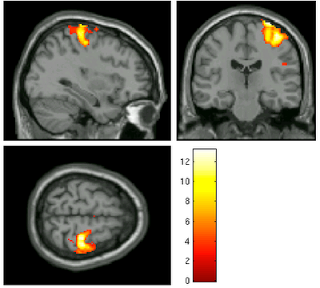
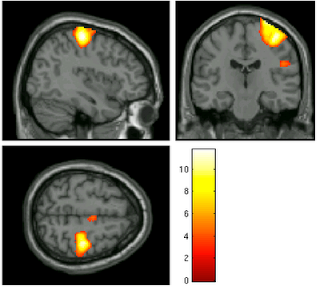
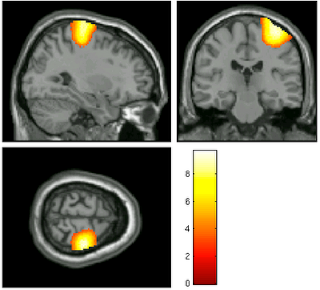
Effect of smoothing kernels on statistical results. Here, a contrast of left-right was performed on datasets smoothed with a 4mm kernel. Note that as the smoothing kernel increases, the peak t-value decreases, as depicted by the thermometer bar.
8mm kernel
15mm kernel


For example, let's say we are interested in the contrast of left button presses minus right button presses, as pictured above; as we increased the smoothing kernel, more and more voxels become part of the big blog - I mean, blob! - and it appears that our power increases as well. However, as we extend our averaging over a wider expanse over the fields and prairies of voxels, we risk beginning to smooth in signal from white matter and increasingly unrelated areas. At the most extreme, one can imagine smoothing in signal from the opposite motor cortex, which, for this contrast, will have strongly negative beta estimates.

Your sensitive FMRI antennae should also be attuned to the fact that smoothing can be applied at different magnitudes in the x-, y-, and z-directions. For example, if you are particularly twisted, you could smooth eight millimeters in the y- and z-directions, but only six millimeters in the x-direction. This also comes into play when estimating the smoothness of a first- or second-level analysis, as the smoothing extent may differ along all three coordinates.

For more details, along with a sample of my writing style as a younger man, see the following posts:

Group Level Smoothness Estimation in SPM

Smoothing in AFNI


Stage Fright


And there you idly sit by the exit sign off of stage right, waiting for the auditorium to fill up; a gradual crescendo in mutterings, greetings, tappings on keypads as the audience swells and the air becomes charged with a strange electricity. Check your watch; only a few minutes remaining. No time to go get a drink or squeeze the lemon; everything you have on you and inside you, goes with you out onto the stage. In a cruel trick of nature, the hands become clammy and cold; those precious extremities that you need under these extreme conditions seem to rebel against you, as the lily-livered blood is able to squirrel itself away deep within your core while the rest of your exposed, unfortunate flesh has nowhere to hide while it faces the enemy. Deserters! Turncoats! Traitors!

Suddenly you become aware of the stage technician repeating a question to you, his tone more insistent; he could have been talking for ages, as far as you're concerned. You nod to him, and the house lights are extinguished - ker-chunk, ker-chunk - you take one deep breath - make that two deep breaths, an additional one for good measure - and walk out onto the stage. The applause rumbles and swells and for a few moments it is a supremely pleasant experience, standing there in the blinding klieg lights and completely unable to see anyone in the audience, only hearing the disembodied plaudits and cheers of the crowd. The walk-on and bow is incredibly easy for any fully functioning, ambulatory being, and were it up to me I would continue to stand there and bow, and let the applause continue.

But it is only a short bow - two bows, an additional one just to make sure - and then its time to seat yourself down on the firm black vinyl of the bench, briefly imagining what other callipygian musicians have sat there as you mindlessly twist the adjustment knobs on the sides. Up a little, down a little, to the side a little, if that option were present. Place your hands upon those surprisingly cool keys, while wondering whether the tremors quivering throughout your body are noticeable by anyone else, or merely insensate. Lastly - and this is the benefit of performing chamber music with a fellow sufferer - you make eye contact with your partner and nod. And then away you go.

As I am happy to rediscover every time, the actual performance is never as horrific as it is played out in my most disturbed nightmares; and although it presents its fair share of anxieties and mistakes and recoveries, it is, on the whole, tremendous fun. The well-timed execution of choreographed looks and gestures, the spontaneous phrasings that you would never have imagined possible, the beautiful chiaroscuro of the piano keys from the angled light, the feeling of having the audience completely enthralled - this is all that is needed to form a healthy and robust stage addiction.

And when the last note is played and the final cadence still reverberates through the air, those few pregnant moments before the cascade of applause are some of the most savory, delicious seconds I have ever had the pleasure of tasting. And even after all of that backbreaking preparation, the cold and windy walks to and from the practice building, the anxiety and worry and the acrid taste of adrenaline in the back of my throat - all I can do is look forward to the next time I hold such ecstatic, terrifying congress with the Muse.

Livestream Link

Just a quick update on the cello recital post yesterday: We have a livestream link for the show which will begin streaming at 5pm EST. http://www.ustream.tv/channel/ryanfitzpatrick

It begins with a solo Bach suite, then the Debussy cello sonata (which Wendelin will accompany), and then a couple of pieces by Respighi and Schumann (which I'll be accompanying for). Click on the link at 5pm, and you should be able to see everything that's going on!

AFNI Bootcamp: Feburary 25th - March 1st


A spectre is haunting America - The spectre of AFNI. A few times every year the good people at the National Institutes of Health (NIH) hold an AFNI bootcamp at various locations around the country and around the world, attempting to teach, persuade, proselytize, inveigle, and coax young FMRI neophytes into using their product. And, fortunately for the rest of us, sometimes these bootcamps are held at the NIH itself, and these are open to any interested researcher.

I went to one of these bootcamps last spring, and it was an eye-opening, pupil-dilating, sphincter-tightening experience. For five full days we talked about, discussed, and analyzed data; and the nerd bacchanalia continued to rage underneath the carmine streaks of the westering sun. Normalization, connectivity analyses, surface mapping, carousing, bear-baiting, and wenching followed upon these lectures as surely as gout follows upon vice; and although I cannot remember anything that was said or taught during these sessions, I do vividly remember how I felt, which was - kind of sore.

Your ticket to paradise can be found here. Registration tends to fill up very fast, so I recommend submitting an application as soon as possible. Most important, the entire event is free (minus your tax dollars). You will, however, have to pay for your own travel, meals, Nutella, and sketchy Travelodge room.

Senior Cello Recital


Tomorrow, Saturday, December 1st, at 5:00pm, I will be accompanying a cellist for his senior recital at Recital Hall. We've put a lot of work into the program, and we think it'll be a great show! (Actually, it has to be, or we don't get paid.) In any case, the music is guaranteed to entertain, enliven, edify, etiolate, and shock the listener; and we hope that you enjoy it as much as we've enjoyed putting it together!

What: Senior Cello Recital, featuring the music of Bach, Debussy, Respighi, and Schumann
Where: Recital Hall, Jacobs School of Music (1201 E. 3rd Street)
Who: Ryan Fitzpatrick (cello), Andrew Jahn & Wendelen Kwek (piano)

Link to the Facebook invite can be found here; we're working on getting up a livestream, which will be posted as soon as it's available.