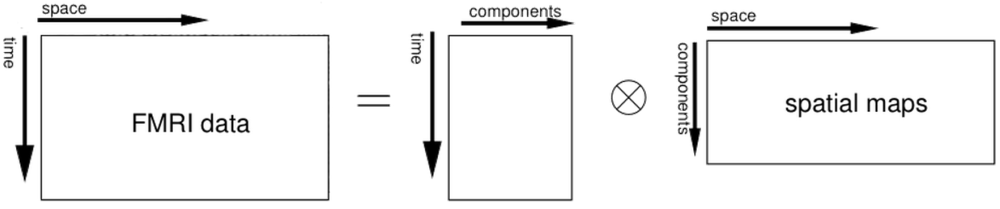
The Next Three Months
This is, barring any unforeseen circumstances, such as meteor strike, death by Nutella overdose, or floss strangulation, my last summer of graduate school at Indiana University; and I will be spending the majority of that time working on my dissertation to escape this durance vile.
However, I have also been thinking (which should worry you), and it appears to me that what this site has become is a pastiche of training and tutorials which deal with small, isolated problems: How to do this for your data, what it means, and then moving on to the next, often without a clear link between the two, and often with a joke or two thrown in for good measure as a diversion to briefly suspend the terror that haunts your guilt-ridden minds. No doubt some come here only to receive what goods they need and then ride on, I no more than a digital manciple supplying a growing, ravenous demand for answers. Some may come here to merely carp and backbite at my charlatanry; others out of a morbid curiosity for ribald stories and for whatever details about my personal life they can divine; and still others, perhaps, see something here that warms something inside of them.
What is needed, however, is a focus on what ties them all together; not only technique and methods, but ways of thinking that will stand you in good stead for whatever you wish to figure out, neuroimaging or otherwise. And, as new wine requires new bottles, a higher-order website is needed to serve as a hub where everything that I have created, along with other materials, lies together; where one is able to quickly find the answers that they need, whether through videos or links to the appropriate tools tools and scripts, along with educational material about the most important concepts to grasp before moving forward with a particular problem. Problem-solution flowcharts, perhaps. Applets that quiz you and record scores, possibly. And, of course, links to my haberdashers. (You think I am making a fortune? Ascots and cufflinks cost more, and without them one would not be in good taste.)
So much for exhortations. Actually putting this into practice is the difficult part, and is an effort that could, quite possibly, kill me from exhaustion, or at least cause me to procrastinate endlessly. We shall see. At least I have taken a few steps towards starting, which includes looking at some HTML code and prodding at it thoughtfully through the computer screen with my finger. I'm not exactly sure how HTML works; but at least whenever I am working with it, I take pains to look very concerned and deep in thought.
However, before this endeavor there are still a few matters left to discuss, which I had earlier promised but still haven't delivered yet. In some states I would be hanged for such effrontery; but your continued patience means that either 1) You really, really don't want to read the manual (and who can blame you?), or 2) You find it worth the wait. Regardless, and whatever my behavior suggests to the contrary, I do want to help out with these concepts, but I do not always get to everyone's questions. Sometimes too much time passes, and they are gradually swept into the vast oubliette of other stuff I tend to forget; other times, some emails do in fact miss me, and aren't opened until much later, when it would seem too late to reply. In any case, I apologize if I have forgotten any of you. Below is a brief schedule of what I plan to cover:
1. Independent Components Analysis with FSL
2. Beta Series Analysis in SPM
3. Explanation of GLMs
4. Multiple Regression in SPM
5. MVPA in AFNI
6. An explanation of GSReg, and why it's fashionable to hate it, using example data on the AFNI website
7. Overview of 3dTproject
And a couple of minor projects which I plan to get to at some point:
1. Comparison of cluster correction algorithms in SPM and AFNI
2. How to simulate Kohonen nets in Matlab, which will make your nerd cred go through the roof
We will start tomorrow with Independent Components Analysis, a method considerably different from seed-based analysis, starting with the differences between the two and terminating at a destination calamitous beyond all reckoning; and then moving on to Beta Series analysis in SPM, which means doing something extremely complicated through Matlab, and plagiarizing code from one of my mentors; and then the rest of it in no set order, somewhere within the mists beyond right knowing where the eye rolls crazily and the lip jerks and drools.
Thoughts on Running
Maybe that is why I began my first runs. Alone, out in the fields on the southern edge of Grand Forks, where after you emerged from the thinning treelines there was nothing save fallow fields and flat country cut squarewise by gravel roads, the emptiness of it and the silence of it suggestive of some terrible vastation. Out there on those leveled plains one could feel the wind blow uninterrupted from its travels from some unknown corner of earth and the sun burning into the cracked clay below, nothing out there beyond a few isolated rampikes and a distant horizon where sky bleeds into ground and faraway thunderclouds explode soundlessly.
As the years passed I continued to run and along the way I encountered all manner of runners. I ran with a thin, dark Indian chemist imported from the Malabar coast, and a stocky bruiser from Crawfordsville who, once he heaved his vast bulk into motion, appeared to move solely by momentum. I ran through the forested switchbacks of Paynetown with an erudite librarian from Tennessee and a halfwitted pervert from Elletsville who expectorated thin lines of drool whenever he talked excitedly. I ran a hundred-mile relay in the dead of night accompanied only by a black man with an emaciated form and a head that bobbed wildly as he jogged and an indoor track athlete whose body was adorned with all matter of piercings and gemgaws and a tattoo of an anatomically correct heart stenciled into his left breast.
I ran with an insomniac exhibitionist who, in the brain-boiled delirium of his restless nights, would arise and run through campus clad in his shoes only and only once did he ever encounter someone, and that man probably mistaking him for some kind of crazed phantom. I ran with a pair of gentlemen from Michigan passing through Bloomington who seemed to revere running as some kind of aristocratic sport and I ran with a curlyhaired dwarf of a man from New Hampshire whose friend had suffocated under an avalanche and I ran with an old ultramarathon veteran from Ohio with lymph pooling in his legs and the joints of his knees encrusted with grout who reckoned he'd been running on his feet longer than I had been alive. I ran with a confirmed vegetarian from Rhode Island who spoke fondly of the days when there were no mounts and there were no weapons to adulterate the sacredness of the hunt and animals were run to the outermost limit of exhaustion whereupon their hearts burst silently.
Above all, I ran by myself. I ran through hail the size of grapes and I ran through thunder loud as a demiculverin next to your ear and I ran through heat and humidity seemingly designed to instill craziness into its victim. I ran down valleys of emerald grass and I ran up bluffs fledged with dying trees and I ran through dried gulches, my barkled shoes carrying clods of earth far away from where they were meant to be. I ran down all manner of roads, lanes, boulevards, avenues, trails, and paths. I ran during the meridian of the day and I ran in the inky blackness of the early morning where only the traffic lights showed any animation in their monotonous blinking and I ran until my clothes were rancid and my socks vile and my skin caked with grime and dried sweat. I ran until my hamstrings seized up and several mornings were spent testing the floor gingerly with my toes and feeling under my skin thickened bands of fascia stretched taut as guywires. I ground through workout after workout, spurring myself on with words so wretched and thoughts so horrid until Hell itself wouldn't have me, and I ran until the pain dissolved and was replaced by some kind of wild afflatus.
On the evening of August the eighteenth back in Wayzata I sat down with my father to outline my remaining training for the Indianapolis marathon in November. The old man's calculations included every duplicity, setback, and potential pitfall, until we had sketched out the next three months of my life upon a few thin sheets of paper. For the next seventy-seven days I would follow that calendar to the letter. From time to time the old man's visage would appear in my mind and grin approvingly.
Of the marathon itself, there is little to say. Some men's marathons are glorious; mine are time trials. The most contact I have with another human being is slowly passing him many miles into the race without exchanging any words or glances, merely the tacit acknowledgement of another event like any other occurring in succession until Doomsday. The day itself was cool with a slight breeze; beyond that, my memory recorded little. Tired legs; acid in my throat; a fleeting desire to void myself; steady breathing that seemed to tick off the moments until my inevitable expiration. Five-forties, five-thirties, five-fifties. Crowds of people on the sidelines with signs and noisemakers and cracked pavement underneath. Steady inclines followed by steady declines but most of all simply flat straight planes lying plumb with the vanishing horizon and at this point the mind begins to warp back within itself and discovers within its recesses small horrific lazarettes of insanity. As though I had encountered it all before. As though I had visited it in a dream.
The finish was blurry. My lower calves were shot but I finished just fine and seeing a familiar friend in the corral slapped him on the back which caused him to vomit up an alarming amount of chyme. As medics ran over to him I looked back at the clock and recognized that for the first time in my life had run under two hours and thirty minutes. I sat down wrapped in a blanket that crinkled like cellophane and took a piece of food from a volunteer and sat down, eating wordlessly. Somewhere in the back of my mind, coiled like an embryo, I knew that this was the end of something and that no matter how I tried it would not be put back together again.
I haven't raced since then. I still run regularly, but the burning compulsion has been snuffed out. I imagine that in my earlier years, when I had learned the proper contempt for non-racers, I would view myself now with disdain, but in actuality it feels like a relief. One ancient Greek in his later years was asked how it felt to no longer have any libido. He replied that it was like finally being able to dismount a wild horse.
Automating 3dReHo
#!/bin/tcsh
setenv mask mask_group #Set your own mask here
setenv subjects "0050773 0050774" #Replace with your own subject numbers within quotations
foreach subj ($subjects)
cd {$subj}/session_1/{$subj}.results #Note that this path may be different for you; change accordingly
3dReHo -prefix ReHo_{$subj} -inset errts.{$subj}+tlrc -mask mask_group+tlrc #Perform Regional Homogeneity analysis
#Convert data to NIFTI format
3dAFNItoNIFTI ReHo_{$subj}+tlrc.HEAD
3dAFNItoNIFTI {$mask}+tlrc.HEAD
#Normalize images using FSL commands
setenv meanReHo `fslstats ReHo_{$subj}.nii -M`
setenv stdReHo `fslstats ReHo_{$subj}.nii -S`
fslmaths ReHo_{$subj}.nii -sub $meanReHo -div $stdReHo -mul mask_group.nii ReHo_Norm_{$subj}
gunzip *.gz
#Convert back to AFNI format
3dcopy ReHo_Norm_{$subj}.nii ReHo_Norm_{$subj}
end
On Vacation
I should be back sometime next week - "sometime" being a very flexible word.
Creating Beta Series Correlation Maps
1. Load your beta series map into the AFNI interface and set it as the underlay;
2. Click on "Graph" to scroll around to different voxels and examine different timeseries;
3. Once you find a voxel in a region that you are interested in, write out the timeseries by clicking FIM -> Edit Ideal -> Set Ideal as Center; and then FIM -> Edit Ideal -> Write Ideal to 1D File. (In this case, I am doing it for the right motor cortex, and labeling it RightM1.1D.)
4. Note that you can also average the timeseries within a mask defined either anatomically (e.g., from an atlas), or functionally (e.g., from a contrast). Again, the idea is the same as what we did with previous functional connectivity analyses.
5. Use 3drefit to trick AFNI into thinking that your beta series map is a 3d+time dataset (which by default is not what is output by 3dbucket):
3drefit -TR 2 Left_Betas+tlrc
6. Use 3dfim+ to create your beta series correlation map:
3dfim+ -input Left_Betas+tlrc -polort 1 -ideal_file RightM1.1D -out Correlation -bucket RightM1_BetaSeries
7. Convert this to a z-score map using Fisher's r-to-z transformation:
3dcalc -a Corr_subj01+tlrc -expr 'log((1+a)/(1-a))/2' -prefix Corr_subj01_Z+tlrc
8. Do this for all subjects, and use the results with a second-level tool such as 3dttest++.
9. Check the freezer for HotPockets.
That's it; you're done!
Introduction to Beta Series Analysis in AFNI
So far we have covered functional connectivity analysis with resting-state datasets. These analyses focus on the overall timecourse of BOLD activity for a person who is at rest, with the assumption that random fluctuations in the BOLD response that are correlated implies some sort of communication happening between them. Whether or not this assumption is true, and whether or not flying lobsters from Mars descend to Earth every night and play Scrabble on top of the Chrysler Building, is still a matter of intense debate.
However, the majority of studies are not resting-state experiments, but instead have participants perform a wide variety of interesting tasks, such as estimating how much a luxury car costs while surrounded by supermodels. If the participant is close enough to the actual price without going over, then he -
No, wait! Sorry, I was describing The Price is Right. The actual things participants do in FMRI experiments are much more bizarre, involving tasks such as listening to whales mate with each other*, or learning associations between receiving painful electrical shocks and pictures of different-colored shades of earwax.
In any case, these studies can attempt to ask the same questions raised by resting-state experiments: Whether there is any sort of functional correlation between different voxels within different conditions. However, traditional analyses which average beta estimates across all trials in a condition cannot answer this, since any variance in that condition is lost after averaging all of the individual betas together.
Beta series analysis (Rissman, Gazzaley, & D'Esposito, 2004), on the other hand, is interested in the trial-by-trial variability for each condition, under the assumption that voxels which show a similar pattern of individual trial estimates over time are interacting with each other. This is the same concept that we used for correlating timecourses of BOLD activity while a participant was at rest; all we are doing now is applying it to statistical maps where the timecourse is instead a concatenated series of betas.
Figure 1 from Rissman et al (2004). The caption is mostly self-explanatory, but note that for the beta-series correlation, we are looking at the amplitude estimates, or peaks of each waveform for each condition in each trial. Therefore, we would starting stringing together betas for each condition, and the resulting timecourse for, say, the Cue condition would be similar to drawing a line between the peaks of the first waveform in each trial (the greenish-looking ones).
The first step to do this is to put each individual trial into your model; which, mercifully, is easy to do with AFNI. Instead of using the -stim_times option that one normally uses, instead use -stim_times_IM, which will generate a beta for each individual trial for that condition. A similar process can be done in SPM and FSL, but as far as I know, each trial has to be coded and entered separately, which can take a long time; there are ways to code around this, but they are more complicated.
Assuming that you have run your 3dDeconvolve script with the -stim_times_IM option, however, you should now have each individual beta for that condition output into your statistics dataset. The last preparation step is to extract them with a backhoe, or - if you have somehow lost yours - with a tool such as 3dbucket, which can easily extract the necessary beta weights (Here I am focusing on beta weights for trials where participants made a button press with their left hand; modify this to reflect which condition you are interested in):
3dbucket -prefix Left_Betas stats.s204+tlrc'[15..69(2)]'
As a reminder, the quotations and brackets mean to do a sub-brik selection; the ellipses mean to take those sub-briks between the boundaries specified; and the 2 in parentheses means to extract every other beta weight, since these statistics are interleaved with T-statistics, which we will want to avoid.
Tomorrow we will finish up how to do this for a single subject. (It's not too late to turn back!)
*Fensterwhacker, D. T. (2011). A Whale of a Night: An Investigation into the Neural Correlates of Listening to Whales Mating.
Journal of Mongolian Neuropsychiatry, 2, 113-120.
Extracting and Regressing Out Signal in White Matter and CSF
ReHo Normalization with FSL
3dAFNItoNIFTI ReHo_Test_Mask+tlrc
3dAFNItoNIFTI mask_group+tlrc
setenv meanReHo `fslstats ReHo_Test_Mask.nii -M`
setenv stdReHo `fslstats ReHo_Test_Mask.nii -S`
fslmaths ReHo_Test_Mask.nii -sub $meanReHo -div $stdReHo -mul mask_group.nii ReHo_Norm
gunzip *.gz
3dcopy ReHo_Norm.nii ReHo_Norm
An explanation of these commands is outlined in the video below. Also, suits!
Regional Homogeneity Analysis, Part IV: Normalizing Correlation Maps
However, normalization can also refer to altering the signal in each voxel to become more normally distributed. This makes the resulting statistical estimates - whether betas, correlation coefficients, or z-scores - more amenable for a higher-level statistical test that assumes a normal distribution of scores, such as a t-test. Although there are a few different ways to do this, one popular method in papers using ReHo is to take the mean Kendall's Correlation Coefficient (KCC) of all voxels in the whole-brain mask, subtract that mean from each voxel, and divide by the KCC standard deviation across all voxels in the whole-brain mask.
As a brief intermezzo before going over how to do this in AFNI, let us talk about the difference between 3d and 1d tools, since knowing what question you want to answer will direct you toward which tool is most appropriate for the job. 3d tools - identified by their "3d" prefix on certain commands, such as 3dTfitter or 3dDeconvolve - take three-dimensional data for their input, which can be any three-dimensional dataset of voxels, and in general any functional dataset can be used with these commands. Furthermore, these datasets usually have a temporal component - that is, a time dimension that is the length of however many images are in that dataset. For example, a typical functional dataset may have several voxels in the x-, y-, and z-directions, making it a three-dimensional dataset, as well as a time component of one hundred or so timepoints, one for each scan that was collected and concatenated onto the dataset.
1d tools, on the other hand, use one-dimensional input, which only goes along a single dimension. The ".1D" files that you often see input to 3dDeconvolve, for example, have only one dimension, which usually happens to be time - one data point for every time point. Since we will be extracting data from a three-dimensional dataset, but only one value per voxel, then, we will use both 3d and 1d tools for normalization.
Once we have our regional homogeneity dataset, we extract the data with 3dmaskdump, omitting any information that we don't need, such as the coordinates of each voxel using the -noijk option:
3dmaskdump -noijk -mask mask_group+tlrc ReHo_Test_Mask+tlrc > ReHo_Kendall.1D
Note also that the -mask option is using the whole-brain mask, as we are only interested in voxels inside the brain for normalization.
The next step will feed this information into 1d_tool.py, which calculates the mean and standard deviation of the Kendall correlation coefficients across all of the voxels:
1d_tool.py -show_mmms -infile ReHo_Kendall.1D
Alternatively, you can combine both of these into a single using the "|" character will feed the standard output from 3dmaskdump into 1d_tool.py:
3dmaskdump -noijk -mask mask_group+tlrc ReHo_Test_Mask+tlrc | 1d_tool.py -show_mmms -infile -
Where the "-" after the -infile option means to use the standard output of the previous command.
3dcalc is then used to create the normalized map:
3dcalc -a ReHo_Test_Mask+tlrc -b mask_group+tlrc -expr '((a-0.5685)/0.1383*b)' -prefix ReHo_Normalized
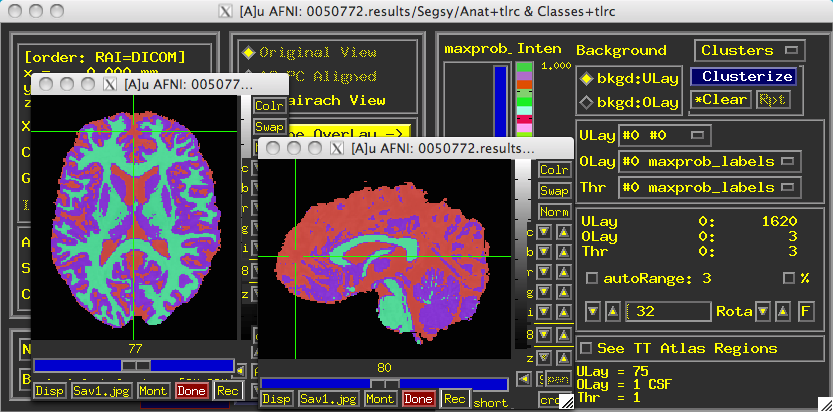
Lastly, although we have used the whole brain for our normalization, a strong argument can be made for only looking at voxels within the grey matter by masking out the grey matter, white matter, and cerebrospinal fluid (CSF) separately using FreeSurfer or a tool such as 3dSeg. The reason is that the white matter will tend to have lower values for Kendall's correlation coefficient, and grey matter will have relatively higher values; thus, normalizing will bias the grey matter to have higher values than the grey matter and CSF. However, one could counter that when a second-level test is carried out across subjects by subtracting one group from another, it is the relative differences that matter, not the absolute number derived from the normalization step.
In sum, I would recommend using a grey mask, especially if you are considering lumping everyone together and only doing a one-sample t-test, which doesn't take into account any differences between groups. As with most things in FMRI analysis, I will leave that up to your own deranged judgment.